|
||
|
Plant synthetic biology: new opportunities for large-scale culture of plant cells
Synthetic Biology Journal
2025, 6 (5):
1107-1125.
DOI: 10.12211/2096-8280.2024-095
Plant Cell Culture (PCC) has emerged as a highly promising chassis for synthetic biology, offering a range of advantages such as short growth cycles, cost-effectiveness, absence of pathogenic risks, and abundant secondary metabolites. These features make PCC an attractive alternative for applications in medicine, food, and health. However, insufficient production efficiency due to difficulties in genetic transformation, complex regulatory networks, cell aggregation, and poor genetic stability remains a major obstacle that limits the commercialization of PCC. Synthetic biology, with its bottom-up engineering design approach, provides a powerful toolkit to address these challenges. By enabling the precise design and modification of native plant cells, synthetic biology offers innovative strategies to develop efficient and economically viable plant cell factories. In this paper, we first review the current status of PCC in synthesizing high-value compounds, particularly recombinant proteins and secondary metabolites. Recent advancements have demonstrated the potential of PCC to produce therapeutic proteins, vaccines, industrial enzymes and bioactive compounds such as alkaloids, flavonoids, and terpenoids. These successes underscore the versatility of PCC as a bioproduction platform. We then explore the role of synthetic biology in advancing PCC industrialization. Key developments include the creation of high-quality plant cell lines through genome editing tools like CRISPR/Cas9, enhancing genetic stability and metabolic efficiency. Additionally, synthetic biology has improved genetic transformation systems, overcoming a critical bottleneck in PCC. Enhanced expression systems, incorporating synthetic promoters and regulatory elements, have significantly boosted target compound yields. Furthermore, synthetic biology has expanded PCC applications by enabling the biosynthesis of heterologous compounds beyond their native metabolic pathways. Finally, we discuss future prospects, emphasizing the potential of synthetic biology to overcome current technical challenges. Emerging technologies including multi-omics integration, machine learning, and synthetic organelle development are anticipated to further enhance PCC’s scalability and efficiency. By addressing these challenges, synthetic biology will pave the way for large-scale plant cell cultivation, thereby facilitating its widespread adoption in industrial bioproduction. The convergence of PCC and synthetic biology holds immense potential for the sustainable, cost-effective, and scalable production of high-value compounds.
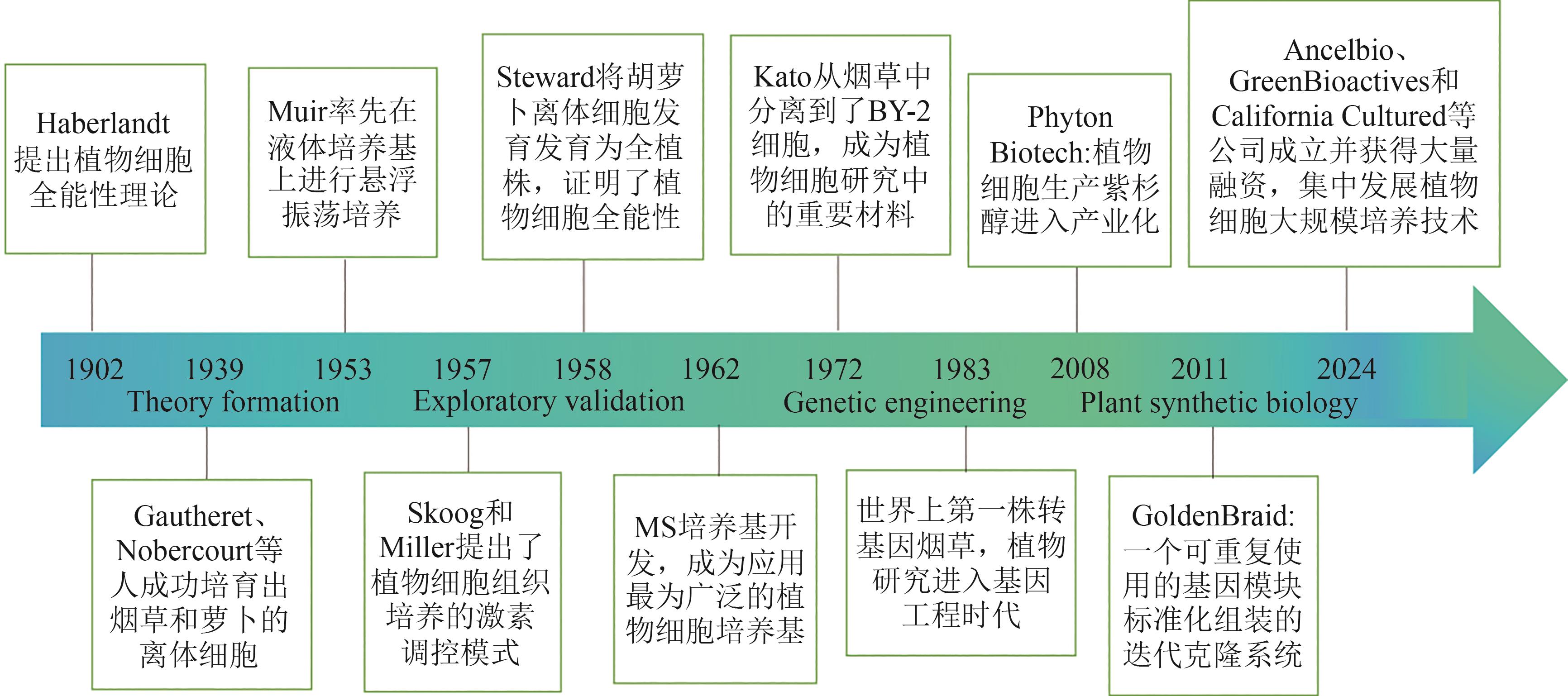
Fig. 1
Time line of plant cell culture development
Extracts from the Article
20世纪初,德国植物学家Gottlieb Haberlandt提出植物细胞具有全能性的理论,为植物细胞离体规模化培养奠定了理论基础(图1)。在这一理论指导下,研究人员成功建立起了烟草、水稻、小麦、胡萝卜、红豆杉、人参、银杏等多种植物的离体细胞系[2-6]。这些离体植物细胞可以在合适的培养条件下进行大规模培养,用于生产紫草素、紫杉醇等天然产物和葡萄糖脑苷脂酶等重组蛋白,在生物制造领域展现出了巨大的潜力[7-10]。其中,德国Phyton生物科技公司利用PCC平台生产的抗癌药物成分紫杉醇,能够满足全球1/3的市场需求,被视为植物细胞大规模培养技术产业化应用的标志性事件[11](表1)。在化妆品领域,来源于PCC的活性成分也备受关注。通过不同溶剂提取的多酚、酚酸、三萜、黄酮类化合物、芪类化合物等化学物质,已经被作为天然护肤成分用于商业化产品中[7]。在食品工业中,可可豆细胞在生物反应器中只需要7天即可收获,被用于大量制造巧克力的原料可可脂(
2.0 mg/L NAA; ... Isolation of the main biologically active substances and phytochemical analysis of Ginkgo biloba callus culture extracts 1 2023 ... 20世纪初,德国植物学家Gottlieb Haberlandt提出植物细胞具有全能性的理论,为植物细胞离体规模化培养奠定了理论基础( Plant cell culture technology in the cosmetics and food industries: current state and future trends 3 2018 ... 20世纪初,德国植物学家Gottlieb Haberlandt提出植物细胞具有全能性的理论,为植物细胞离体规模化培养奠定了理论基础(
Other Images/Table from this Article
|